

By Jeff Carter
Think about the first spring day, that first day when you can walk outside without a coat, the warm afternoon sun on your bare arms, the brighter green of the plants around you, and the smell of open fresh air. All winter long, we’ve essentially shielded ourselves from nature, hiding from the weather while bathing in artificial light. Combine that with all the time we spend passively entertained by flickering screens, and it’s easy to see how we all suffer from a “Nature Deficit Disorder” most of the time. So when Spring finally arrives, it feels really good. It’s a therapeutic return to what we’ve been missing. The first days of spring are a healing reconnection to something we all need— time in Nature.
Now think about your kids. A generation or so ago, most kids enjoyed plenty of time outside, playing around with friends in the neighborhood, exploring nearby woods and fields. They weren’t drawn to video games, smart phones, and the internet. Attending school often meant being inside, but their “free time” was spent outside bumping up into the real world. As we know, this is sadly not the case for most modern kids. Much of their childhood has been captured by a “winter” of living indoors and on screens.
Richard Louv, who we’ve mentioned before, has published an interesting article discussing the benefits of outdoor play for children, the problems caused when it’s neglected, and what we as parents might do to encourage it.
The article is in the March-April 2007 issue of Orion magazine, and is entitled “Leave No Child Inside” (link to the full article). Louv has no trouble documenting an overall decline in the amount of time American kids spend outside, and likewise the numerous problems associated with this “virtual house arrest.” In particular, he highlights “threats to their independent judgment and value of place, to their ability to feel awe and wonder, to their sense of stewardship for the Earth—and, most immediately, threats to their psychological and physical health.” Growing up divorced from experiencing the richness of the natural world seems to have clear negative consequences.
A Movement to Reconnect
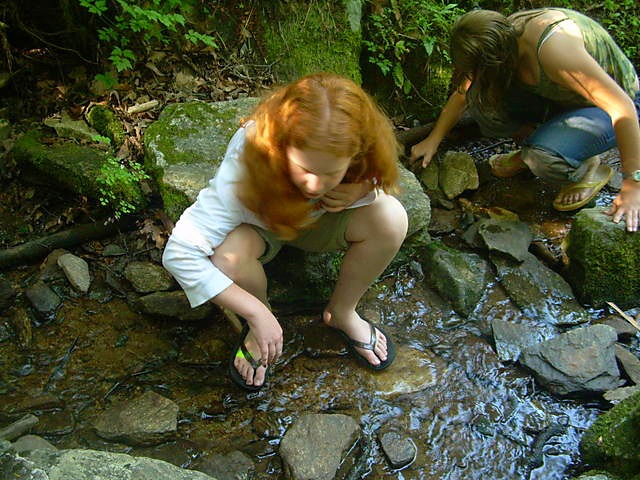
Despite the forces behind this “nature-deficit disorder” (the article cites, “disappearing access to natural areas, competition from television, smart phones and computers, dangerous traffic, more homework, and other pressures”), Louv also finds a “growing movement to reconnect children and nature.” What’s crucial here is the positive childhood experience of nature most of us adults share and recall fondly. No matter what our current profession, level of income, or political views, we love those experiences… turning over rocks in the stream, hiking through tall ferns, catching a glimpse of a hawk overhead… and we want our children to have them too.
Louv’s point is that with this kind of broad agreement on an issue— the value of time in nature— we should be able to do something about it. There’s power to this movement because “no one among us wants to be a member of the last generation to pass on to its children the joy of playing outside in nature.”
Fortunately there is camp. There is a special community intentionally designed to help children reconnect with the the natural world, a place where outdoor play is central. Camp is haven from the isolating forces of the modern world where kids and be kids, explore, and enjoy the richness of nature. It sounds simple, but they need it, and the good news is that they love it too.